JUSTICE BUILDING BLOG

WELCOME TO THE OFFICIAL RICHARD E GERSTEIN JUSTICE BUILDING BLOG. THIS BLOG IS DEDICATED TO JUSTICE BUILDING RUMOR, HUMOR, AND A DISCUSSION ABOUT AND BETWEEN THE JUDGES, LAWYERS AND THE DEDICATED SUPPORT STAFF, CLERKS, COURT REPORTERS, AND CORRECTIONAL OFFICERS WHO LABOR IN THE WORLD OF MIAMI'S CRIMINAL JUSTICE. POST YOUR COMMENTS, OR SEND RUMPOLE A PRIVATE EMAIL AT HOWARDROARK21@GMAIL.COM. Winner of the prestigious Cushing Left Anterior Descending Artery Award.
Showing posts with label The Year Of Dangerous Days; Janet Reno; Arthur McDuffie; Riots; Mayhem. Show all posts

Tuesday, August 02, 2022

ENGLISH ONLY

UPDATE: As the comments alerted us yesterday, DOM's client in Colorado federal court was convicted. We abhor Monday Morning Quarterbacking on trials, but we did see some of the pre-trial motions and the defense had an uphill battle. Accidental discharge of a FA is a difficult defense in the best of cases. But  DOM and his team did what we are supposed to do- they fought with all their skill and effort to protect their client, in the best traditions of our craft. And make no mistake, if and when the gov comes for your blogger, there is only one lawyer we are hiring- David. And although he does not need solace, this is where we find comfort after a loss: The Man In The Arena.  (and BTW- he and his wife Mona are a hell of an appellate team. Just ask the 11th cir. It's not over till it's over.) 

More From The Year of Dangerous Days (most of the information is taken from chapter 21). Quotes are taken directly from the book, as is the story line we used. 

The Mariel boatlift dropped an additional third of the total Miami population on an unprepared Miami in less than two months. It was like “having Providence, Rhode Island dropped into Dade County without any provisions for schools, housing, or jobs.”

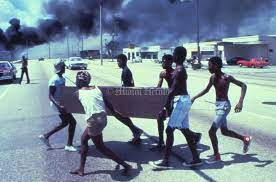
The immediate aftereffects of the riot following the McDuffie acquittal was brutal. Large swarths of Overtown and Liberty City was burned to the ground. Most stores were looted and destroyed,  never to return. Old time REGJB regulars may remember Wally Leahy, Ted Mastos’s bailiff when Ted was a Judge (and Ted’s father-in-law at the time!). Wally had owned  (we are doing this from memory) a type of meat/ butcher/convenience store in Overtown. He helped feed the neighborhood and employed members of the community. After his store was looted and burned in the McDuffie riots, he never returned. He was not alone. Most businesses abandoned Black Miami, and in the aftermath, no bank would give loans to businesses wanting to re-open.

Miami became the center of the news media world, with every major outlet adding staff, and the Herald having fifty reporters covering it all (today David Ovalle feels very lonely indeed). Russian news agencies said Miami was an example of "mixing capitalism with race and immigration."

Governor Bob Graham proposed to raise Dade’s sales tax by 1% to raise $291 million for rebuilding Liberty City and Overtown. But the rest of Florida viewed the riots in Miami as Miami’s own fault and the mostly white, Anglo southern legislators in Tallahassee voted down the bill.  The Herald reported that house members and their aides then sang “Dixie” and “It’s Hard to be Humble when you’re perfect in every way.”

Miam was on its own, and it was not done ripping itself apart.

Cuban refugees were housed in the Orange Bowl, scared of the crime and violence they had witnessed, they huddled worried and confused. Miami Cuban businessmen went to the OB and gave hours long lectures on things like getting around, renting an apartment, getting a job and even explaining what a parking ticket was and whether it had to be paid.

Into this mix and mess of riots, arson, destruction (old time REGJB regulars like us recall walking into our beloved Justice Building as it was known then, under the watch of armed National Guard troops) and abandonment by the rest of Florida and the US, walked a small slight, Russian born immigrant named Emmy Shafer and her new organization Citizens of United Dade. Shafer was a survivor of Auschwitz. She spoke six languages, but not Spanish, and CUD had one goal: placing ENGLISH ONLY on the ballot-and enacting laws banning Spanish on public signs, 911, and hurricane warnings, to name a few. Don't even think about speaking Spanish in public schools. 

Anglo Miami wanted integration and communication: “How can we have communication in grocery stores if we don’t speak the same language?” Black Miami stayed out of the issue,  busy trying to figure out how to rebuild and bring back jobs. And Hispanic Miami went ballistic, feeling their heritage was under attack. One Anglo woman spoke for many when she said on TV “Make me a refugee so I can have some rights.” That kind of resentment resonated not just in White Miami, but in Black Miami as well. Hispanic Miami shuddered, feeling the rest of Miami just didn’t get the immigrant experience. 

At the time Miami most needed to come together- race, language, culture and heritage was about to rip Miami apart deeper and worse than even the riots had done. The wounds would be deep, the scars hard and long lasting. Remnants still exist today. It is only the current Millennials, born well after riots and nonsense like English only dominated the news, who do not feel the resentment that older Miami residents still feel to this day. Talk to an African American Man or Woman in their sixties and they will tell you of the feelings of hopelessness and rage over the McDuffie verdicts. Talk to a Cuban who came from Mariel, and they will tell you of the feelings of not being wanted and cursed at and called "spic" when all they wanted was the same chance that generations of immigrants before them had. Their only involvement in McDuffie was bad timing- arriving right when the city went up in flames. Talk to older White Miamians and they will explain the feelings of bewilderment at how their peaceful city exploded. Miami didn't acquit the cops who killed Arthur McDuffie- Tampa did. 

Nobody understood the other two sides of the triangle. And each side was certain the other two sides were against them. These problems were never really settled. There was no peace, just a stalemate as people aged and moved away and died. Mayor Fere's vision for Miami came into being because of people connected to each other through the internet and social media. Millennials wanted to enjoy the success of Miami facing south- their anger reserved only for the slow barista at Starbucks, or the Door-Dash driver who showed up late. 

We got what Mayor Fere wanted; we just got here in a way neither he nor anyone who watched Miami burn could have imagined.  

Sunday, July 31, 2022

THE RIOTS

More from Year of Dangerous Days, Chapters 19 and 20 (quotes are directly from the book, as is the storyline that we worked from).

Saturday May 17, 1980, the 138th day of the new decade, dawned warm and clear. A typical Miami spring day. The heat of summer was looming. In Tampa, all of the police officers who killed Arthur McDuffie were acquitted in the early afternoon. As the unexpectedly early verdicts were being announced, the chiefs of the PSD (now Metro Dade PD) and City of Miami were standing with Janet Reno in African Square Park in Liberty City for a community event. At 2:30 pm beepers started going off. People went to pay phones and word began to spread- every cop on trial had been acquitted. There would be no justice for Arthur McDuffie. Six white jurors in Tampa had acquitted all the officers in just a few hours after a six-week trial- or in the words of Miami Herald reporter Joe Oglesby “in the time it took to eat supper.”

Reno got a terse message from George Yoss “No dice. Sorry Boss.”

Police officers evacuated Janet Reno as the brass made plans to mobilize. Black radio stations stopped the music as outraged DJs began to discuss the verdict. Bruce Springsteen sings “you can’t start a fire without a spark” in Dancing in the Dark.  Dusk was falling on Miami. It would soon be dark, in more ways than the night.

Three Herald photographers were attacked in their car in Overtown blocks from the Herald Building on Biscayne Bay. The windows were shot out; the vehicle dented by concrete blocks and rocks. The Herald chief of security ran to a nearby supermarket and bought gallons of cooking oil to pour down the slope leading to the building to slow down a mob.  On 62nd street, Michael Kulp a teenager and his brother Jeffrey were pulled from their car and beaten to death by a mob. Then shot. Then stabbed. Then repeatedly run over by a car as young black children watched.


Police cars on the streets were randomly shot at. Three thousand people- almost all black,   marched towards the PSD headquarters (which is now the PDs building -how many of you 30 something judges knew that?) shouting “Justice Justice Justice”.  Gunshots rang out. The crowd’s blood was up. Althea Range- Miami’s first black city commissioner, holding a bullhorn and shouting to keep the peace could not be heard, or was ignored: “She looked as slight as a sparrow in a storm.”

Rocks came through the windows of the HQ, “bullets snapped against the walls” and the lobby was breached despite the efforts of George Knox, the City of Miami's first Black City Attorney.  PSD officer Lonnie Lawrence, born and raised in Miami, raced to the lobby and confronted the mob: “Brothers and sisters do not come into this building…or a lot of you will be dead…there are a lot of people armed and ready to take people out.” The crowd retreated. But it was not over.


A squad of riot officers arrived at the Justice Building just as the mob arrived. Rocks rained down on the officers from the overpass; cars exploded; Molotov cocktails were thrown; a sniper opened fire on the officers who took refuge behind a police car which then exploded hurling a major and his officers across the street.  A SWAT team arrived, and the sniper stopped.

All the police could do was set up perimeters around Liberty City and Overtown. On the same street the Kulp brothers were killed, a 14-, 15- and 21-year-old were pulled from a car and beaten to death with rocks and hammers.

By daybreak 213 fires had been reported in Liberty City alone.” When firefighters arrived, they were shot at and retreated. At the Norton Tire factory, which was the biggest employer in Liberty City, 100,000 tires burned, casting a thick, black smoke over most of Miami. Close to 500 people were treated in hospitals that night.

Then the violence flipped. White men in a truck shot a black 14-year-old boy in the head as he ran across the street.  A black man trying to stop teenagers from throwing rocks at cars was shot in the back and killed by a white man whose windows in his truck were shattered by the rocks.

The civil-race war was on. “PSD received 22,000 calls in 48 hours.” Janet Reno, whose phone number was in the phone book and answered her phone at home, moved her mother out of their house because of the death threats she was receiving. 

In one month, May 1980, the boatlift and the McDuffie verdict shattered all that Mayor Fere had spent years building. Miami was no longer the future business and banking center of the Americas; it was a warzone. The National Guard showed up to restore order. The image of the city was not a Cuban Banker giving an Anglo business a loan to build in Overtown. It was the Norton Tire company on fire; dead people in streets, and officers huddling behind cars as they were shot at, while cars slowly drove down the streets with stolen refrigerators and furniture strapped to their roofs.

Calls went out for Janet Reno to resign. As the mayor in Coral Gables was speaking, one of his assistant city attorneys was shot when the police he was riding with stopped to end the looting of a salvation army store. Three men in a car pulling away opened fire. Refugees in the  Orange Bowl climbed to the top of the bleachers and watched their new town burn.

White voters across Florida regarded the burst of immigration, cocaine bloodshed and riots …somehow the fault of Floridians to the south.”

Miami, bloodied, burned, ruptured and bleeding was alone. And it was going to get worse.

Next Up: English Only. 

Wednesday, July 27, 2022

THE YEAR OF DANGEROUS DAYS

Few amongst the twenty-five-year-old assistant prosecutors and PDs and thirty-five-year-old judges know how the Miami they work in and Instagram about came to be.

There are four names directly responsible for Modern Miami. From those names come a chain of several dozen other names like Edna Buchannan (Herald Crime reporter) that made Miami what it is today.  Most of our readers under 40 can probably only identify two or three. We hazard no one can identify them all.

The names are: Janet Reno; Maurice Ferre’; Arthur McDuffie; and Napolean Vilaboa.

Reno was the State Attorney in Miami in 1980. Recently appointed, she was puzzling about how to respond to an alarming rise in the murder rate- including an unheard-of traffic shootout in broad daylight between Colombian Drug dealers. The new head of the Public Safety Department’s Homicide Division (MDPD used to be PSD)  Frank Marshall was to soon experience the infamous Reno scowl as his detectives repeatedly failed to get a grand jury to indict the suspects they arrested near the scene of the shootout.

Maurice Ferre’, a Puerto Rican, was the mayor of Miami.  Uneasy about Cuban support for his reelection, Ferre’ had a direct line to Jimmy Carter’s White House and the remarkably novel view that the future of Miami was not- like Miami leaders believed for the last hundred years-facing north. Ferre’ believed Miami’s future was south- to Central and South America and saw Miami as the future banking and commerce capital of the Americas.  Faced with an unpredictable Fidel Castro in 1979-80 who was suddenly amenable to allowing Cubans to leave, Ferre’ shouted Que Vengan Todos! (let them come) as Jimmy Carter concentrated on his reelection and counted on allies in Central and South America to help take in what he figured would be a few thousand refugees at most.

Arthur McDuffie- born in Overtown, a decorated Marine and successful insurance salesman was the unlikely catalyst to the explosions that would rock Miami to its core and nearly burn it to the ground. All because McDuffie unfortunately had a suspended driver's license. 

Napolean Vilabos is the most unknown of the four. A car salesman and member of the secret Miami Committee of 75-  a group of successful Cuban businessmen in Miami who had back door communications with Fidel Castro and his government.

One April morning in 1979 Napolean Vilabos decided to take US foreign relations into his own hands. He had received word through Castro that Cubans in Miami could go pick up their families by boat from a non-descript port named Mariel. On April 21, 1979 Vilabos led a flotilla of eight boats from Key West to Mariel to get members of his own family. Miami leaders speculated that perhaps five hundred or a thousand people would be allowed to leave Cuba via Mariel.  

 Vilabos’s flotilla broke a dam which had begun to leak with the most unlikely of events- a disaffected Cuban bus driver named Hector Sanyustiz, having been previously imprisoned for upsetting a Cuban official during a bus ride, crashed a bus through the gate of the Peruvian embassy in Havana and successfully sought refuge and asylum. Castro- unable to get Peru to return Sanyustiz- removed his guards surrounding the embassy. With the gates to the embassy broken open by the bus, first a few, then a dozen, then a hundred and then thousands of Cubans streamed into the Peruvian embassy in Havana seeking asylum. Miami Cubans rallied for their compatriots and suddenly there was a humanitarian crisis as thousands of people without food and water huddled on Embassy grounds waiting for the world to come to their rescue as Castro starved them.

Miami from 1900 to the 1970s was a parochial southern town that had some national appeal due to tourism. In reality Miami was several towns- the tourists had Miami Beach; there was the Anglo parts of Miami; Jewish parts of Miami;  the historic African American communities of Overtown, Liberty City and The Black Grove; and Little Havana for the Cuban refugees from 1959-60. Each part of Miami and each community had their own competing interests. Pressure was slowly building, and then 1979 and 1980 happened and Miami blew apart like Mt. St.  Helens. 

Several seemingly unconnected threads came together in 1978-79-1980 that caused Miami to fracture. Before new Miami could emerge, the old and fractured Miami had to die. The disaffected Cuban bus driver who would later storm the Peruvian embassy was released from prison the day Arthur McDuffie was beaten to death in Miami. Napolean Vilabos's small flotilla arrived in Mariel on the day prosecutor George Yoss gave the opening statement in the McDuffie murder trial. The FBI was investigating the PSD’s homicide squad for corruption right when the new State Attorney and new chief of homicide were facing a puzzling and dramatic increase in the murder rate over a new and unknown phenomenon – cocaine and the drug wars. 

Hundreds of thousands of refugees came pouring in to Miami just as billions of dollars of drug money washed ashore literally and figuratively. Lawyers cashed in; cops took bribes; the feds had no money laundering laws on the books to enforce; Janet Reno struggled to keep law and order as everything and everyone around her went slightly mad. Mayor Ferre’ touted the promise of America-Que Vengan Todos!- as he saw his town overrun by criminals and was abandoned by the president he helped elect four years earlier. The flood of drug money was such that the Miami Federal Reserve in 1980 had several billion dollars in cash while the rest of the Federal Reserve Banks had about a hundred million each. Cocaine was that big back then in our small city. 

Miami 1980. Sounds like the makings of a great book.

It is. 

All of the madness of Miami 1980 is pulled together in The Year of Dangerous Days-Riots, Refugees and Cocaine in Miami in 1980,  by Nicholas Griffin.

The book details Reno and George Yoss and Hank Adorno plotting prosecution strategies while defense attorneys like Eddie O’Donnell, Roy Black, Joel Hirschorn, Richard Sharpstein and Jack Denaro formed a Miami criminal defense bar that was to become the best in the nation. 

Edna Buchannan, in late December of 1979, having gotten a tip about McDuffie, was pushing cops to talk about a seemingly simple motorcycle accident that did not make sense to her or legendary medical examiner Dr. Joe Davis and ME Dr. Ron Wright who did the autopsy on McDuffie. Buchannan inspected McDuffie’s motorcycle at the impound lot before the homicide investigators did (she was that type of reporter) and she sniffed out that what the cops were calling an accident was a brutal murder. McDuffie’s murder-uncovered as much by Buchannan as PSD Homicide’s famous detective Al Singleton,  and the trial and acquittal of the cops that killed him, was the final spark that lit the flame that blew the top off what was a smallish southern city with some pale tourists soaking up the sun on a stretch of Miami Beach every winter.

It's a great book. We highly recommend you place it at the top of your summer reading list.