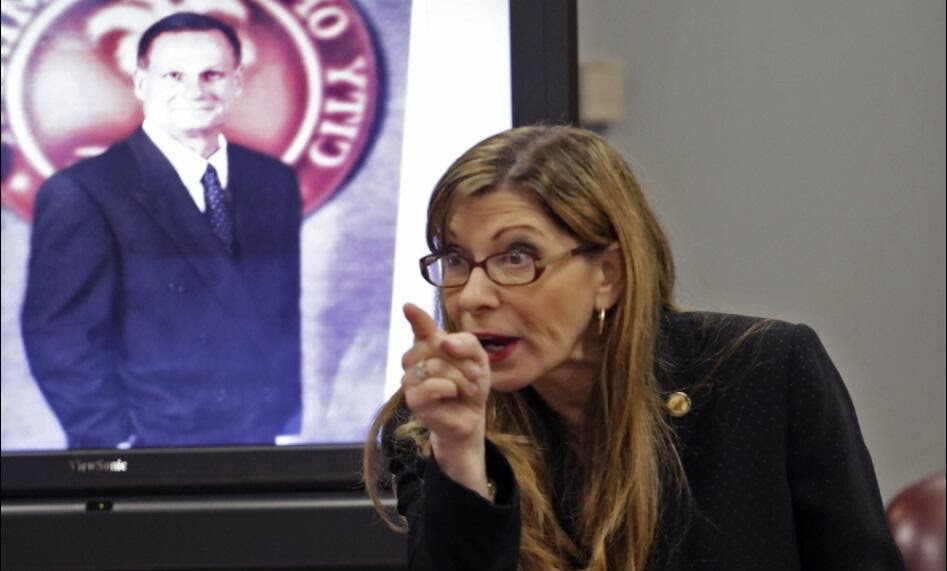
Update: Our dear friend David O Markus's most difficult blog post: remembering his great father Stuart Markus, who passed away Sunday.
Ovalle/Herald Obit here: Best line was by Judge Milt Hirsch- "He was like Atticus Finch....the last small town lawyer in this big town." Is there any higher compliment a lawyer could receive?
Dr. Martin Luther King, Jr., took the last trip of his life to Memphis, Tennessee in 1968, to fight not for the rights of African Americans, but to support striking sanitation workers. King was planning a second "March on Washington" to duplicate the success of the march he led in 1963. This march was to focus exclusively on economic rights and poverty. But King never made it out of Memphis alive.
Last Friday we took a cheap and gratuitous shot at the Dade State Attorneys Office on the issue of race, and a few readers rightfully called us out on it. But before you go awarding the SAO a Spirit Of Dr. King Award, the fact that they don't overtly discriminate on the basis of color does not relieve them of their responsibility for recognizing the causes of the crime they prosecute.
King knew that the challenge for the next generation would not be race, but poverty.
Poverty is a spirit crushing form of discrimination more insidious than racism. The causes of poverty are for another discussion and perhaps another blog. But the effects of poverty on the criminal justice system need to be recognized and discussed.
What do you think the mean income is for any random selection of individuals in custody in the Dade County Jail? What do you expect a child who is born into poverty, only knows his father through jail cells, and has a mother who is a crack addict to become? An engineer? A poet? Or a drug dealer?
Yes, remarkable examples exist of remarkable individuals who beat the odds and pulled themselves up from less than nothing. But those who cite such examples ignore the phrase "beat the odds".
When a prosecutors' office incarcerates a generation of young, poor, poverty stricken individuals who know nothing but crime, and who have never known anything but poverty and crime, then their actions are worse than racist.
Let's be clear: our prosecutors' office is not racist. But they are blind and deaf to the root of the problem, which is not the color of a person's skin, but the poverty in to which they were born.
Do rich kids from Pinecrest commit crimes? Sure. But examine one significant segment of the population of individuals being prosecuted: those against whom the state is seeking the death penalty. How many were born and raised in Pinecrest or Coral Gables to a stable family? How many had good medical care, educational opportunities, safe home environments, time for play and exposure to arts and music and literature and travel before they ended up a defendant in a death case? Sure you can cite the Joyce Cohen case and one or two others, but we venture that more than 95% of defendants facing the death penalty come from abject poverty and unstable-unsafe home environments. (FN1).
So what does that mean? Poor people are just more likely to be vicious killers? Well, actually, yes and no. Because while there is no simple answer, most killers are made, not born, and they are made by their environment.
The statistics can be extrapolated to almost every type of quality of life crime (but strangely not such crimes like stock fraud). Who gets arrested for street narcotics sales? Purse snatchings? Senseless and tragic robberies of nails salons? This is not to say we should not fully prosecute the thugs who senselessly killed that poor innocent child in the nail salon recently.
But if we don't understand what drove that young man to rob that nail salon and what created the type of individual who has no respect for human life, then we are all in danger. Because we cannot incarcerate the 16% of US society that the 2010 census says lives in poverty. But that is what we see every prosecutors' office trying to do. And to be fair, they are just enforcing the laws promulgated by the legislature. But then again, there used to be laws against Colored People and Jews drinking from the same water fountains in Miami Beach as white people. We looked at a home recently (for a friend) in Bal Harbour that had a restrictive covenant in the deed forbidding the sale of the home to individuals of "1/4 negro blood or 1/8 Jewish blood". And that used to be the law.
So the Dade SAO does not get a pass for blindly enforcing the law without making any attempt (that we can see) to understand what causes the crimes they prosecute. They have a PTI program for first offenders but that doesn't help the 19 year old from Liberty City on his 11th arrest. Something caused that kid to get arrested all those times.
And indeed it was the "content of his character and not the color of his skin." But fifty years after Dr. King dreamed about a society where his children were judged by the content of their character, it's time we start asking what role poverty plays in forming the content of character? Until that happens, we are no better than the sheriff enforcing Jim Crow laws and racist restrictive covenants in deeds.
See You In Court.
FN1: The proof of this is undeniable. The National Association for the Advancement of Colored People (NAACP) wrote the following in its release “Talking Points: Suspend the Death Penalty,” published on www.naacp.org (accessed Aug. 4, 2008):
“The death penalty is the most lethal form of social injustice in the United States. The race and class bias which permeates the American justice system result in this most extreme punishment being handed out almost exclusively to the poor…
Nearly all of the 3,500 Americans awaiting execution on death row today have low-income backgrounds…